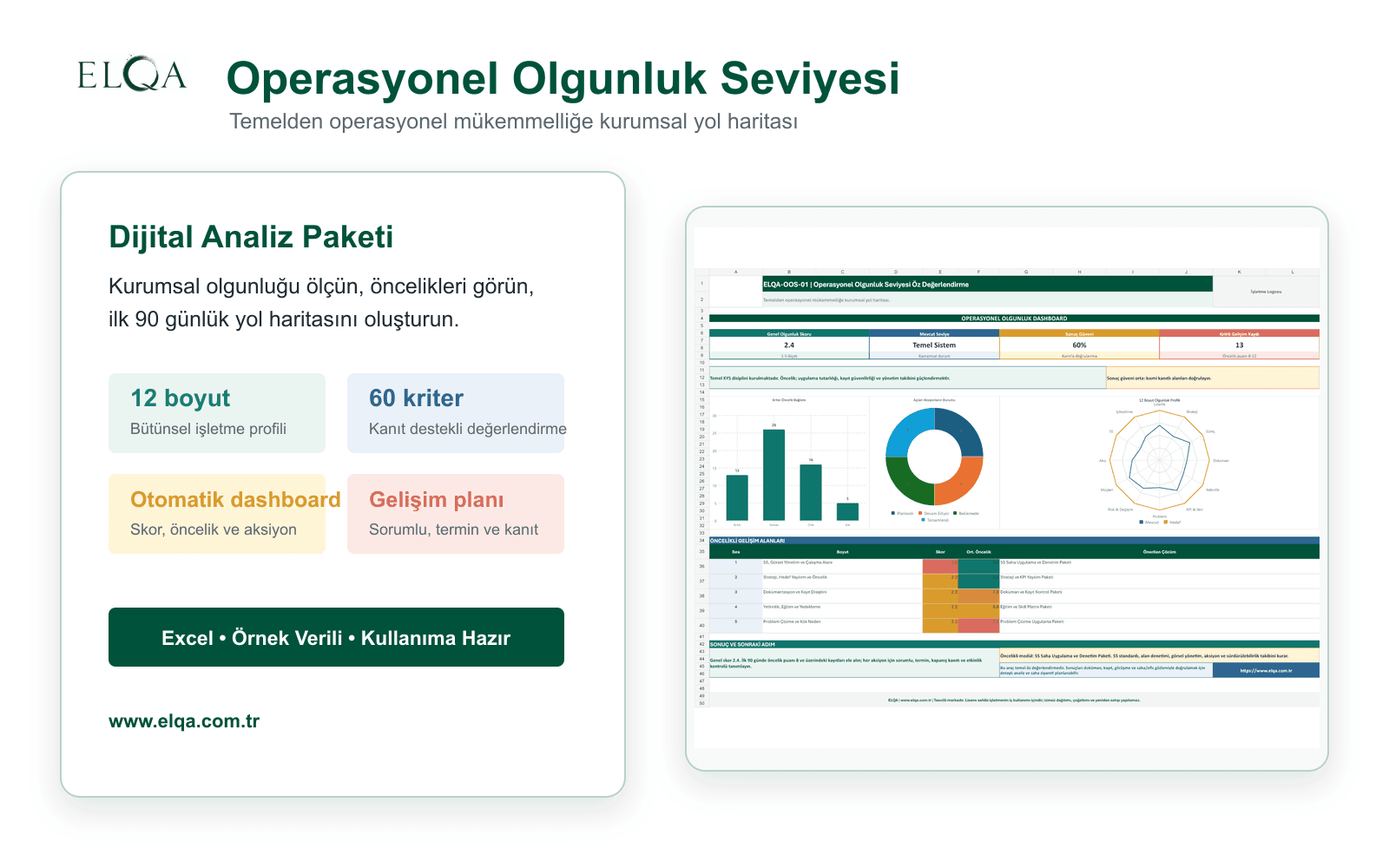
Cover of the Operational Maturity Assessment Excel toolkit
ELQA-OOS-01
Operational Maturity Self-Assessment Toolkit
A corporate roadmap from foundational capability to operational excellence.
Assess your organization’s management system, operational discipline and development priorities across 12 dimensions and 60 criteria.
- 12 corporate and operational maturity dimensions
- 60 evidence-based assessment criteria
- Five conceptual maturity levels
- Critical, Important and Supporting impact classes
- Result confidence based on the state of evidence
- An automatic development roadmap
- A header area reserved for the organization’s own logo
- Macro-free .xlsx file structure
₺995,00excl. VAT
₺1.194,00 incl. 20% VAT
As soon as payment is confirmed, the files become available in your account.
Related services
What does this toolkit give you?
The Operational Maturity Self-Assessment Toolkit lets manufacturing and service organizations see their current state not as a single overall score, but across 12 distinct dimensions that management can act on.
For each criterion, the user selects from a drop-down list the level the organization applies consistently today and can evidence. The tool evaluates the selected maturity level, the weight of the criterion and the state of the evidence together, then updates the overall score, the result confidence, the distribution of priorities and the development roadmap.
The toolkit starts from the basic system discipline expected by ISO 9001 and extends to process management, documentation, competency, KPIs, problem-solving, risk, customer focus, flow, 5S and continuous improvement. The organization therefore sees both its current picture and the order in which it should launch its first wave of improvement.
Sections of the workbook
A ready-made structure the purchaser can adapt directly.
Dashboard and Management Summary
Overall score, priorities, action status and the 12-dimension profile.
Self-Assessment
60 criteria, five maturity levels and an evidence record.
Impact and Priority Logic
Weightings for critical, important and supporting criteria.
Development Roadmap
Tracking of actions, owners, deadlines, status and effectiveness.
Assessment Guide
Explanations of levels, evidence confidence and scoring.
Guidance Based on Results
A recommended solution for the priority development area.
Five maturity levels
For each criterion, you select the level the organization applies consistently today and can evidence.
- 1
Person-Dependent Operation
Work runs on individual experience and initiative; standards, records and follow-up discipline are fragmented.
- 2
Basic System Discipline
The basic process, record and responsibility structures expected by ISO 9001 are in place; consistency of application is the development area.
- 3
Controlled and Measurable Operation
Processes, KPIs, records and responsibilities are visible; deviations are monitored and linked to actions.
- 4
Lean and Data-Driven Management
Flow, losses, problem-solving, competency and action management are run on data; there is a rhythm of improvement.
- 5
Benchmark / Culture of Excellence
Improvement is part of daily work; standards spread, learning becomes institutional and a benchmarking approach emerges.
The 12 dimensions assessed
- 01Leadership and Management Rhythm
- 02Strategy, Goal Deployment and Priorities
- 03Process Management and Standard Work
- 04Documentation and Record Discipline
- 05Competency, Training and Succession
- 06KPIs, Data and Management Dashboards
- 07Problem-Solving and Root Cause
- 08Risk, Opportunity and Change Management
- 09Customer Focus and Feedback
- 10Flow, Efficiency and Loss Management
- 115S, Visual Management and the Workplace
- 12Continuous Improvement and Learning
What is in the package?
User workbook (.xlsx)
A blank assessment file, ready to use straight away.
Worked example file (.xlsx)
A completed example scored at 2.4 that shows the dashboard and calculation logic.
Quick Start Guide (.pdf)
A four-page walkthrough of the workflow, the scoring logic and the 90-day implementation rhythm.
Licence and Terms of Use (.pdf)
Permitted use, branding, distribution and resale conditions.
Sample Results Report (.pdf)
Management summary, the 12-dimension profile, the priority view and a sample 90-day roadmap.
How is it used?
- 01Open the blank user file.
- 02Update the organization, scope and assessor details.
- 03In the yellow cells, select the current level and the state of the evidence.
- 04Add the evidence or an explanatory note.
- 05Review the dashboard results.
- 06Turn the critical and high-priority records into a roadmap.
Who it is for
- Manufacturing and service organizations
- SMEs and growing businesses
- General managers and senior leadership teams
- Quality, operations and continuous improvement managers
- Process owners and department managers
- Organizations looking to strengthen their ISO 9001 foundation
- Teams building a corporate structuring and lean transformation roadmap
What you get
- A structured self-assessment of the organization’s current maturity level
- A view of strengths and areas for improvement across 12 dimensions
- A result confidence score that separately reflects the quality of evidence
- A ranking of the critical and high-priority criteria
- A one-page dashboard ready for a management meeting
- A starting framework for the first 90-day development plan
Technical details
- File format
- Microsoft Excel .xlsx and PDF
- Macros
- None
- Recommended use
- Excel desktop or Microsoft 365
- External data connection
- None
- Internet connection
- Not required for the Excel tool
- Licence
- Internal use by the single purchasing legal entity
Frequently asked questions
This product is a foundational self-assessment and development planning tool. It does not replace ISO 9001 certification, a conformity guarantee, a certification audit or independent on-site verification. The results are limited to the selections made and the evidence entered by the user. In a detailed analysis, the results are verified through documents, records, interviews and on-site observation.
See where your organization stands and build your first 90-day roadmap.